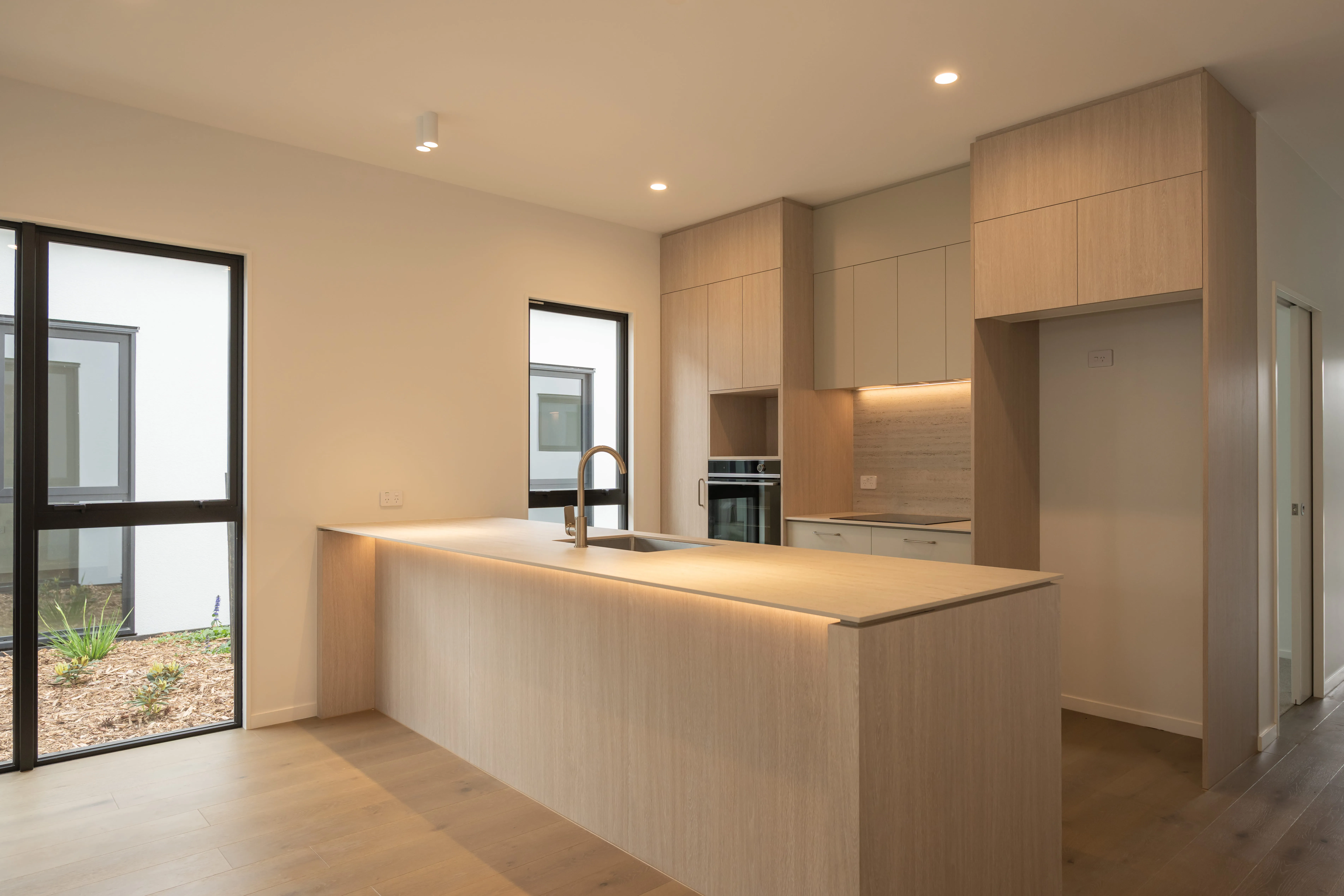
Stand in a showroom and look at three cabinet doors side by side: one in timber veneer, one in melamine and one in laminate. From a few steps back, they can look almost identical. A woodgrain melamine can pass for timber, and a good laminate can look like either.
Up close and over years of use, they behave very differently. They're made differently, they wear differently and they suit different parts of a home or business. This guide explains each one in plain English, using finishes we've built with on real projects, so you can choose with confidence. If you're still getting your head around the wider trade, our guide What Does Joinery Cover? A Canterbury Guide is a good place to start.
What is timber veneer?
Timber veneer is a thin sheet of real wood bonded to a stable board, usually MDF. The MDF gives the panel its strength and keeps it flat. The veneer gives it the look, feel and grain of solid timber.
Is timber veneer real timber? Yes. Veneer is sliced from a real log, so every sheet has natural grain and colour variation, just like solid wood. The difference is that it's used as a surface layer rather than a solid plank, which makes it more stable and allows large, consistent panels that solid timber can't easily achieve.
How the veneer is cut affects the look. Quarter-cut veneer, for example, produces a straighter, more even grain that suits clean, contemporary joinery.
How we finish veneer
Veneer arrives raw, so it needs finishing to protect it. We seal ours with a two-pack lacquer in a clear finish. We don't stain it. The aim is to keep the timber's natural colour and protect it from moisture and daily wear.
A good example is Edizi in Christchurch's CBD. The building had three existing concrete columns that couldn't be moved. We clad them in American white oak quarter-cut veneer and sealed them with a clear two-pack lacquer, turning structural necessities into features. The same veneer runs through the back bar, with full-height shelving and backlit panels, so the timber ties the whole room together.
That's what real timber does well: it brings warmth and character, and it ages with the space.
What is melamine?
Melamine is a low-pressure laminate, often called LPL. A decorative paper is fused onto a board under heat and lower pressure, creating a hard, sealed surface. It comes in solid colours, textures and woodgrain designs, and is widely used for both cabinet fronts and carcasses, the inside boxes of cabinets.
Modern melamine is a long way from the plain white shelving many people picture. Good-quality boards have realistic textures and matched edging, and they look sharp in a finished room.
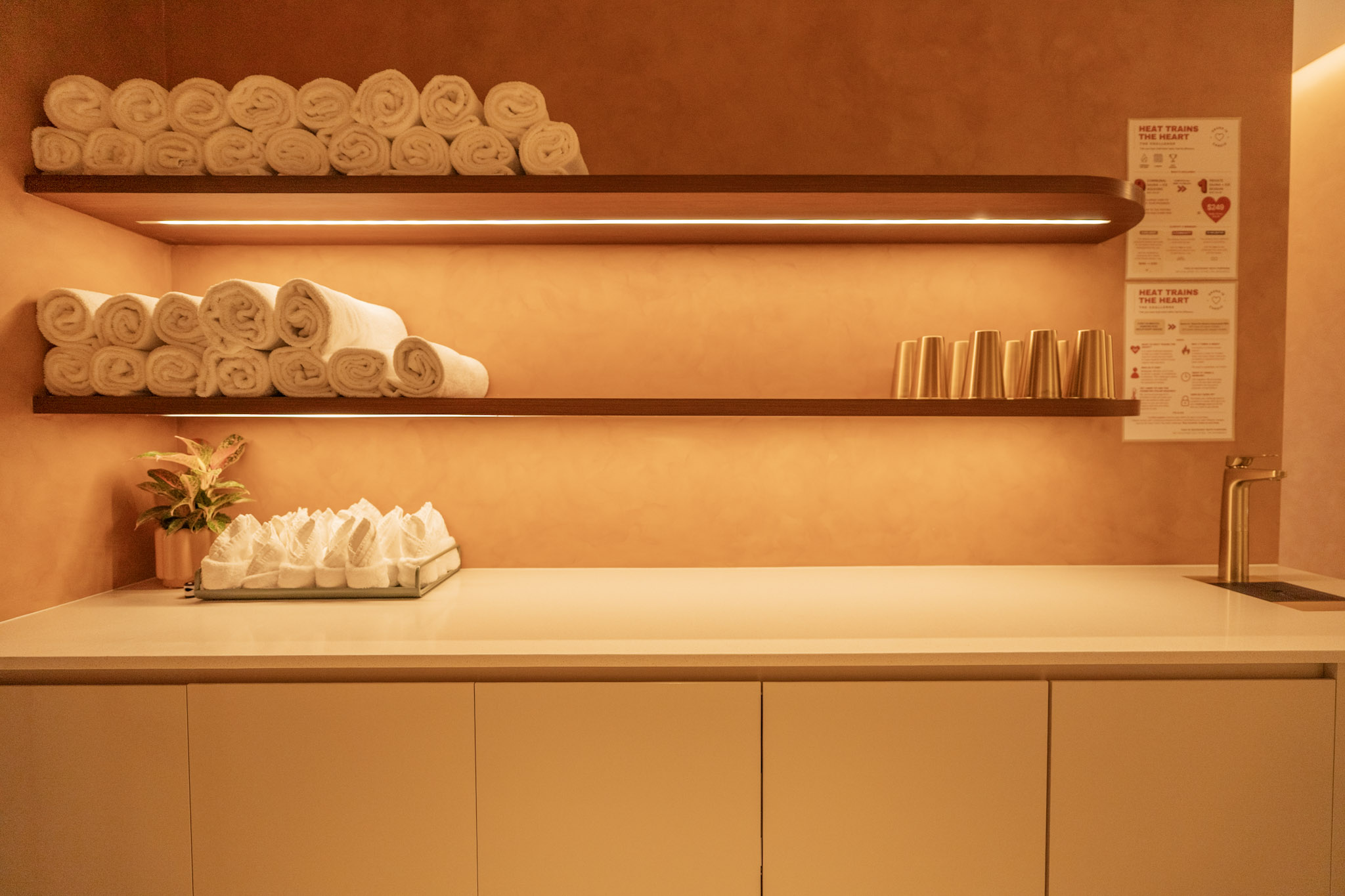
At O-Studio, the cabinet fronts throughout the facility are a warm, neutral melamine. It runs from the change rooms through to the recovery lounge, giving the space a calm, consistent look while standing up to the daily demands of a busy commercial wellness facility.
What is high-pressure laminate?
High-pressure laminate, or HPL, is made by pressing multiple layers together under much higher pressure. The result is a tougher, more impact-resistant surface than melamine.
That toughness is why HPL was traditionally used on benchtops, especially in older kitchens. You'll still see it on hard-working surfaces where impact and wear resistance matter more than a natural look.
Timber veneer vs melamine vs laminate: a quick comparison
Timber veneer
- Look: real timber grain and natural colour variation
- Durability: good when properly sealed, but can mark with heavy knocks
- Repairability: light marks can often be refinished
- Suits best: feature walls, statement pieces and visible joinery
Melamine (LPL)
- Look: solid colours, textures or printed woodgrain
- Durability: hard-wearing and easy to clean, suits daily use
- Repairability: damage is harder to repair invisibly
- Suits best: wardrobes, laundries, cabinet carcasses and fronts
High-pressure laminate (HPL)
- Look: a wide range of colours and patterns
- Durability: very tough, with high impact and wear resistance
- Repairability: damage is harder to repair invisibly
- Suits best: hard-working surfaces such as benchtops
How to choose
Most projects don't pick just one. The best results usually come from using each material where it does its best work.
Choose real timber veneer where people will look and touch. Feature walls, statement cabinetry, reception counters, back bars and shelving are where veneer earns its place. It brings warmth and authenticity that a printed surface can't fully match, and it becomes a talking point in a room.
Choose melamine where practicality comes first. Wardrobes, laundries and cabinet carcasses work hard and need to be easy to keep clean. Melamine handles that well and frees up room in the budget for the feature pieces. Our wardrobes and dressing rooms are a good example of where a quality melamine makes sense.
Choose high-pressure laminate where impact resistance matters most, such as hard-working surfaces that take knocks every day.
A common approach is to pair them: veneer on the visible feature joinery, melamine on the fronts and carcasses that need to be practical. Done well, the materials complement each other, and the room feels considered rather than mixed.
Caring for each finish
Whichever you choose, a little care goes a long way:
- Timber veneer: wipe with a soft, damp cloth and dry it off. Avoid harsh or abrasive cleaners, and don't leave water sitting on the surface.
- Melamine: a mild detergent and a soft cloth are all it needs. Avoid scourers, which can dull the surface.
- High-pressure laminate: very easy to clean, but use a chopping board and trivets rather than cutting or placing hot pans directly on it.
Seeing the difference in person
Finishes are much easier to judge in person than on a screen. Natural grain, texture and the way a surface catches the light all come through better in your hand. That's why we encourage clients to come into our showroom and look at samples side by side before deciding.
If you're weighing up finishes for a home or commercial project, talk to us and we'll help you work out where each one belongs.